Translate

Monday, 22 April 2013

Hesketh 308

This is a car which was at the Silverstone Historic Tribute meeting in June 2004 and is the Hesketh 308C driven by 1976 World Champion James Hunt in the 1975 season.


The car was driven at Silverstone in the Grand Prix Masters race by Graham Willcox

The car is shown in the program as a Hesketh 308C-2 and most photographs of the Hesketh 308 in this livery show it with a different nose. When Lord Hesketh pulled out of racing the existing team cars and the design itself went through a variety of upgrades and changes as this ten-tenths.com forum details.

Friday, 19 April 2013

Friday's Ferrari


This is a car seen at Donington Park at the SeeRed meeting in September 2005. It's a Ferrari 275GTB, the car which succeeded the 250 model and was followed by the 365GTB Daytona. You can read about it in the Supercars.net website here. The car's serial number is 09247.


Wednesday, 17 April 2013

Guernsey and Grandson Edward

We were over in Guernsey last week for the Thanksgiving Service for our grandson Edward last Sunday. As well as all the local relatives and friends other friends of Paul and Anna had travelled over from the mainland with their children and on the Saturday we all went for a walk along Vazon beach. As you can see the weather was still cold enough to ensure we were well wrapped up.
On the Sunday Anna's Uncle Nick, who's a Bishop in Argentina and was over here for a few days, conducted the Thanksgiving part of the service. In the photo below it looks as if Edward's thinking: "What's he mean, 'Talk to the Hand'?"
After the service it was all back to Anna's parents' house where the adults relaxed inside the house, whilst the children found things to do in the garden, here with the help of Edward's other grandad.
We didn't return home till Thursday, so saw quite a bit of Edward over the next few days.
Wrapped up well against the cold for a trip out
"Look, I can wiggle my finger!"
With Mummy and what looks like the start of the croupy cough
With Daddy and wearing his favourite shoes

Friday, 12 April 2013

Friday's Ferrari

This car seen at Donington Park in June 2003 is a 1970 Ferrari 512 S driven by Frenchman Olivier Cazalieres. It's pictured in the pit lane going for a practice run at the Richard Seaman Memorial Trophy meeting at Donington Park.

This is what the site howstuffworks has to say about the Ferrari 512 S. This car is serial number 1016.

Tuesday, 9 April 2013

Alfa Romeo 6C

This is a car which comes under the broad label of Alfa Romeo 6C and to be specific it's a 1930 Alfa Romeo 6C 1750 Gran Sport.
The photograph was taken on the car park in front of the old Manchester Exchange railway station opposite Manchester Cathedral in May 1992 at the start of the Manchester to Blackpool Veteran and Vintage car run organised by the Lancashire Automobile Club. The programme says that the car belonged to a Malcolm Hoyle of Linthwaite near Huddersfield.

Friday, 5 April 2013

Friday's Ferrari

Last week's photograph was of a line of cars featuring four different Ferraris at the Coys International Historic Festival meeting at Silverstone in August 2001. Today we have photographs of the cockpits of three of those cars:
This is the 1954 Ferrari 750 Monza, serial number 0568M

This is the 1957 Ferrari 250 Testa Rossa, serial Number 0738TR.

This is the 1950 Ferrari 166MM Barchetta, serial number 0040M.

You will notice that, although they are Italian cars, two of the three are right-hand drive instead of the expected left-hand drive. This is because races at most circuits (in Europe at least) are run in a clockwise direction. Most of the corners are therefore right-hand ones and having right-hand drive cars is advantageous as far as weight distribution and the driver's view of the apex of the corner are concerned. I don't know why the Testa Rossa is left-hand drive; I have photographs of other examples of this Testa Rossa model which are right-hand drive.

Tuesday, 2 April 2013

500cc racing cars - Formula 3 of the 1950s

When I first started watching motor racing at Oulton Park and Aintree in the mid-1950s most meetings included in the support races an event for the 500cc Formula 3 cars. These usually produced close and exciting racing and even the star Grand Prix drivers would frequently take part in the races. This is what Wikipedia says about the Formula:

'History
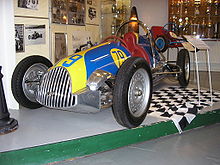

A typical early car, the Effyh 500 (1947–1952) was built in Malmö, Sweden and was one of the more successful cars. It had a lightweight tube chassis, aluminium bodywork and was powered by a 500cc JAP engine.
Formula Three (adopted by the FIA in 1950) evolved from postwar auto racing, with lightweight tube-frame chassis powered by 500 cc motorcycle engines (notably Nortons and JAP speedway). The 500 cc formula originally evolved in 1946 from low-cost "special" racing organised by enthusiasts in Bristol, England, just before the Second World War; British motorsport after the war picked up slowly, partly due to petrol rationing which continued for a number of years and home-built 500 cc cars engines were intended to be accessible to the "impecunious enthusiast". The second post-war motor race in Britain was organised by the VSCC in July 1947 at RAF Gransden Lodge, 500cc cars being the only post-war class to run that day. Unfortunately the race was a complete flop, as three of the seven entrants were non-starters, and, of the four runners, all but one were out of it in the first lap, leaving Eric Brandon in his Cooper Prototype (T2) trailing round to a virtual walk-over at the unimpressive speed of 55.79 mph, though his best lap (which was the fastest recorded for any 500) was 65.38 mph.
Cooper came to dominate the formula with mass-produced cars, and the income this generated enabled the company to develop into the senior categories. Other notable marques included Kieft, JBS and Emeryson in England and Effyh, Monopoletta and Scampolo in Europe. John Cooper, along with most other 500 builders, decided to place the engine in the middle of the car, driving the rear wheels. This was mostly due to the practical limitations imposed by chain drive but it gave these cars exceptionally good handling characteristics which eventually led to the mid-engined revolution in single-seater racing.
The 500cc formula was the usual route into motor racing through the early and mid 1950s (and stars like Stirling Moss continued to enter selected F3 events even during their GP careers). Other notable 500 cc Formula 3 drivers include Stuart Lewis-Evans, Ivor Bueb, Jim Russell, Peter Collins, Don Parker, Ken Tyrrell, and Bernie Ecclestone.
From a statistical point of view, Don Parker was the most successful F3 driver. Although coming to motor racing late in life (at age 41 in 1949), he won a total of 126 F3 races altogether, and was described by Motor Sport magazine (in his 1998 obituary) as "the most successful Formula 3 driver in history." Although Stirling Moss was already a star by 1953, Parker beat him more than any other driver, and was Formula 3 Champion in 1952, again in 1953, and in 1954 he only lost the title by a half-point. He took the title for a third time in 1959.
In 1954, Parker took on a young man named Norman Graham Hill as his mechanic and general assistant, and gave him his first taste of competitive motorsport in a 500cc car at Brands Hatch. Some years later, now using his middle name of Graham, this young man twice became Formula 1 World Champion (1962 and 1968).
Don Parker retired shortly after the 1959 season, having chosen not to move to Formula 2 or Formula 1, and thereafter raced only occasionally. However, he maintained his enthusiasm for fast cars, and in 1961 Jaguar built him a specially modified high-performance Mark 2 3.8 litre saloon. This car was reputedly the fastest Mark 2 ever built, having been tested at 140 m.p.h. on the recently opened (but still unrestricted) M4 motorway.
500cc Formula Three declined at an international level during the late 1950s, although it continued at a national level into the early 60s, being eclipsed by Formula Junior for 1000 or 1100 cc cars (on a sliding scale of weights).'
____________________________________________________________________________________________
Races for the 500cc cars are often a feature at Vintage and Historic car meetings and here are some photographs which I took at the Seaman Memorial Trophies meeting at Oulton Park in June 1982:
The 1954 Cooper Mk VIII of D Price

The 1951 Cooper Mk V of R Wright at Lodge Corner

The 1955 Cooper MK IX of J Turner, also at Lodge Corner. He seems to be taking an altogether more leisurely  approach than Mr Wright!